
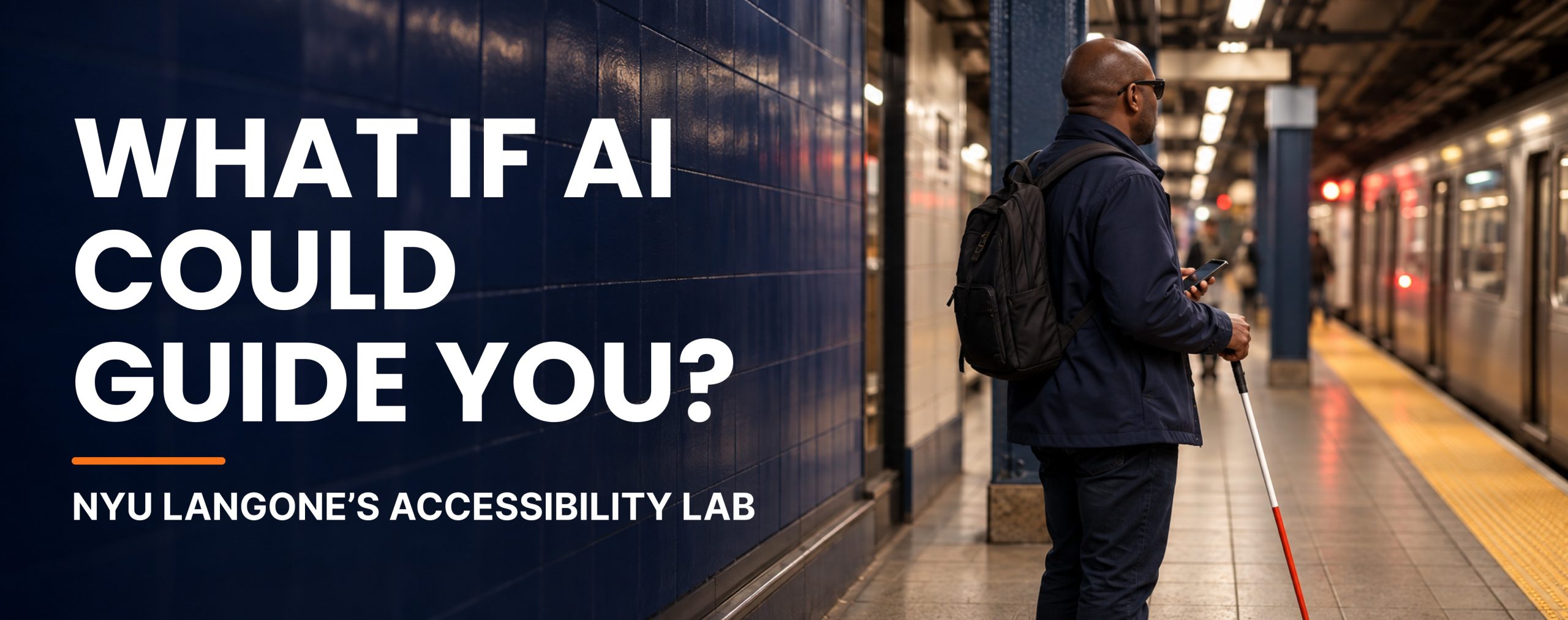
There’s a room inside NYU Langone on Manhattan’s East Side that looks like a medical office. Cameras, sensors, half-built prototypes, a mock-up of a subway station assembled from scratch. It looks more like a hardware startup than a hospital wing.
That’s the point. The team working there isn’t treating vision loss. They’re engineering around it.
Leading the effort is Dr. John-Ross Rizzo, a physician who is legally blind himself — which turns out to matter enormously. The tools coming out of his lab aren’t designed from assumptions about what blind people need. They’re designed from lived experience of what’s actually broken.
The problem with “just order it online”
Ask most people how a blind person should handle grocery shopping and you’ll get a quick answer: delivery apps exist. Problem solved.
Rizzo pushes back on that hard. Convenience isn’t the same as independence. Outsourcing a task doesn’t give someone agency over it — it just removes them from it. As he told CBS News, he likes to “pick my own damn produce.”
That distinction runs through everything the lab builds. The goal isn’t to do things for blind users. It’s to make the physical world legible enough that they can do things themselves.
Three tools, three everyday obstacles
Shopscout: navigating the grocery aisle
Shopscout is a wearable backpack fitted with a camera that helps a blind shopper find specific products on a shelf. Rather than reading out a wall of text, it guides the user’s hand with audio beeps that intensify as they get closer to the item.
Rizzo compares the experience to Marco Polo — the childhood pool game of hot and cold. You listen, you adjust, you close in. It’s a deceptively elegant design choice: instead of forcing the user to translate verbal instructions into physical movement, the sound is the instruction.
Commute Booster: reading the subway
Anyone who’s used the New York City subway knows the signage is dense and the soundscape is chaos. Dr. Giles Hamilton Fletcher, also on the NYU Langone team, notes that station noise alone makes orientation difficult — audio cues that work in a quiet hallway get swallowed underground.
Commute Booster is a smartphone app that reads MTA signage for the user. Snap a photo, and the app explains where you are and where you need to go next. The team built a makeshift subway station in the lab to test it under realistic conditions.
The result is the number that should get transit agencies’ attention: blind and low-vision travelers finished their journeys 33% faster using the app.
Unav: GPS for the inside of buildings
GPS stops being useful the moment you walk through a door. Unav is the lab’s answer — an indoor navigation app that maps entire buildings and works without a cell signal. The user takes a picture, the app identifies their location, and it routes them to where they’re going.
For a hospital, an airport terminal, or a government building with four wings and no logic to the numbering, that’s a meaningful gap to close.
Why this isn’t only about blindness
Here’s the part that should reframe how you think about accessibility work: the beneficiaries usually extend well beyond the original user group.
Unav doesn’t only help blind visitors. It helps an elderly patient trying to find the right clinic, a caregiver arriving late and stressed, anyone who has ever stood under a hospital directory feeling completely lost. Rizzo’s team points out that assistive tech has a long history of graduating into the mainstream — dictation software and the electric toothbrush both came out of accessibility labs before becoming things nobody thinks twice about.
Their guiding principle is simple: design for disability and you end up designing for everyone. Rizzo describes the blind community as encountering the future ahead of everybody else, which is less a slogan than an accurate description of how innovation tends to move.
The takeaway for anyone building technology
Three things stand out about how this lab operates, and they generalize far past accessibility.
Lived experience changes the spec. A sighted engineer optimizing grocery shopping would likely build a better delivery interface. Rizzo built a tool that gets a blind shopper to the produce section, because he understood that shopping was the point.
Test in the mess, not the lab. Building a fake subway station indoors sounds excessive until you consider how many assistive tools work beautifully in a quiet demo and fall apart in a real station at rush hour.
The output should be measurable. “It felt easier” doesn’t move institutions. A 33% reduction in journey time does.
What comes next
Prototypes still have to become products, and that’s rarely the easy half. Manufacturing, cost, durability, MTA and hospital partnerships, and the ordinary question of whether someone wants to wear a camera backpack to the store — all of it is still ahead.
But the direction is clear. AI in accessibility is moving past narrating the world and toward actively guiding people through it. That’s a different category of tool, and the New Yorkers testing it are already navigating the city faster because of it.


