
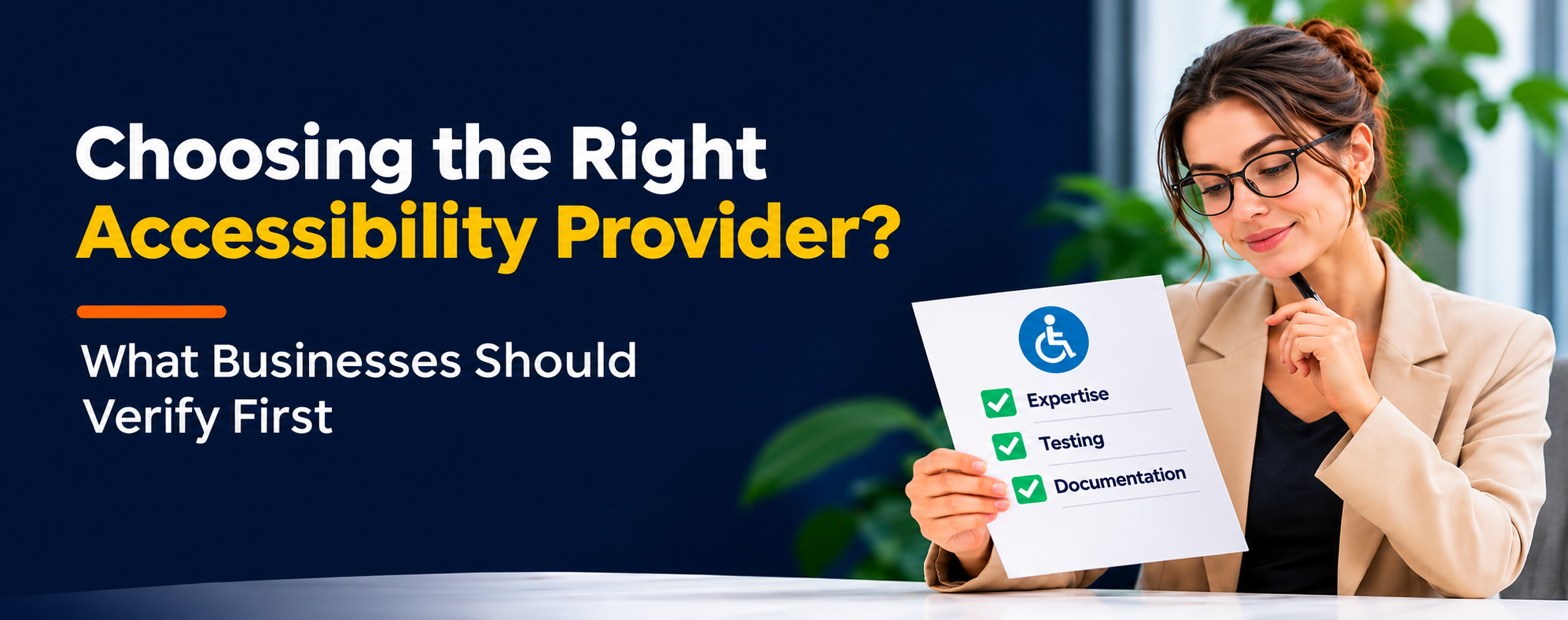
A practical guide to verifying expertise, testing, documentation, and long-term accountability before trusting any provider with accessibility work.
Key message: The issue is not whether a provider is a freelancer or a company. The issue is whether you can verify their accessibility expertise, testing process, documentation, and ability to support your organization when you need them later.
Hiring a freelancer can be a smart way to complete many website tasks. But accessibility is different from ordinary design or development work. If your business is trying to improve access for people with disabilities, meet WCAG requirements, respond to an accessibility complaint, or reduce legal exposure, the quality of the provider matters far beyond the initial project price.
There are highly qualified independent accessibility professionals in the industry. The risk appears when a business hires someone through a general freelance marketplace without verifying their background, methodology, deliverables, or ability to provide support after the project ends. A profile that says “ADA expert” or “WCAG specialist” is not, by itself, proof of expertise.
Why Accessibility Work Requires Specialized Expertise
Website accessibility cannot be reliably addressed by running one automated scanner and fixing whatever appears in the report. Accessibility involves how real people use navigation, forms, menus, product pages, checkout flows, dialogs, media, and other interactive features with keyboards and assistive technologies.
The U.S. Department of Justice specifically notes that automated accessibility checkers can be useful, but a clean automated report does not necessarily mean a website is accessible. The DOJ recommends pairing automated tools with manual checking. W3C guidance on WCAG 2.2 similarly explains that accessibility evaluation requires more than simply relying on automated results and that many requirements need human judgment.
That means the person performing the work should understand WCAG, semantic HTML, keyboard behavior, screen readers, focus management, accessible names, forms, dynamic content, color contrast, multimedia, and practical usability—not just how to run a scan.
Accessibility also has a human dimension that ordinary bug fixing does not. A technically valid page can still be difficult to use if focus moves unpredictably, instructions are unclear, or a control makes sense visually but not through a screen reader. That is why businesses should ask how a provider evaluates complete user journeys, not just individual code violations.
Five Risks of Hiring an Unverified Accessibility Freelancer
1. You may not know the person’s real accessibility background
A polished marketplace profile can show ratings and completed jobs, but businesses should still verify relevant accessibility experience. Ask about previous audits, remediation projects, assistive-technology testing, references, certifications, and the standards the provider works against. Professional credentials are not the only measure of skill, but independent verification can help you evaluate whether claims are credible. For example, the IAAP Certified Professional Directory can be used to verify certain accessibility certifications.
2. Automated testing may be presented as full compliance
Some low-cost services consist mainly of running an automated tool, correcting a limited set of errors, and declaring the site “ADA compliant.” That is a major warning sign. Automated tools are valuable for finding certain issues quickly, but manual evaluation is necessary to assess many real-world barriers. W3C’s WCAG 2.2 guidance is a useful reference when evaluating the standard a provider claims to follow. Ask exactly which pages, user journeys, screen readers, browsers, devices, and manual checks will be included.
3. You may receive fixes but no useful documentation
Accessibility work should leave your business with a record of what was evaluated and what happened next. A professional engagement may include the audit scope, WCAG findings, remediation notes, retesting results, outstanding third-party issues, and final documentation. W3C’s Accessibility Evaluation Report Template provides a useful example of the type of information an evaluation report can document, including scope, reviewers, review process, results, and recommended actions.
Without those records, it can be difficult to show what was tested, what was fixed, and when the work occurred. An invoice that simply says “ADA fix completed” may provide very little help months later.
4. The provider may disappear after the project
Websites change constantly. Themes are updated, apps change, marketing teams publish new content, and developers release new features. New accessibility barriers can be introduced after a successful remediation project.
If the original freelancer closes the account, changes careers, or is simply unavailable, your organization may have no one familiar with the prior work. You may then have to pay another provider to re-audit the site and reconstruct the history of the project. Before hiring, ask what post-project support is included and how long project records are retained.
5. There may be no one to support your legal team if a complaint arrives
This is one of the most important questions businesses overlook. If an accessibility demand letter or lawsuit arrives six months after remediation, your attorney may need the original audit, remediation history, technical explanations, updated testing, or assistance reviewing specific allegations.
A short freelance engagement may not include that type of support. In one published accessibility lawsuit case study, EcomBack describes its role in auditing, remediation, testing, and supporting a client during an ADA website accessibility matter. That kind of continuity is easier when accessibility is treated as an ongoing program rather than a one-time task.
What Should You Verify Before Hiring Any Accessibility Provider?
Whether you are considering a freelancer, consultant, agency, or accessibility company, apply the same due diligence. Ask which WCAG version and conformance level they test against; whether manual testing is included; which assistive technologies they use; who performs the remediation; whether fixes are retested; what reports you will receive; what happens if third-party apps create barriers; and what support is available after completion.
You should also ask whether the provider can work with your developers and, when appropriate, communicate technical findings to your legal team. These questions help distinguish a defined accessibility process from a task-based service with no long-term accountability.
Request a written scope before work begins. It should identify the pages or templates being reviewed, the testing standard, the testing methods, what remediation is included, what is excluded, the expected deliverables, and the support period. If the provider relies on subcontractors, ask who will actually perform the audit and remediation. Clear scope protects both sides and makes it easier to compare proposals based on substance rather than price alone.
Freelancers Are Not the Problem—Unverified Services Are
A qualified independent accessibility professional can be an excellent choice. Likewise, simply hiring a larger company does not guarantee quality. Businesses should evaluate the evidence behind the provider’s claims.
Look for a documented testing methodology, experienced reviewers, manual and assistive-technology testing, code-level remediation capability, clear deliverables, retesting, and ongoing support. Be cautious of anyone promising “100% ADA compliance,” “guaranteed lawsuit protection,” or complete accessibility based only on an automated scan or quick plugin installation.
The right question is not, “Is this person a freelancer?” It is: “Can this provider demonstrate the expertise, process, documentation, and accountability our organization needs?”
Accessibility Should Be an Ongoing Business Program
Accessibility is not a box to check once. A sustainable program generally follows a cycle: audit, remediation, manual testing, user testing where appropriate, documentation, monitoring, training, and periodic retesting.
EcomBack’s website accessibility audit and remediation process combines manual and automated auditing, remediation, disabled-user testing, retesting, documentation, and ongoing support. Businesses looking for broader website accessibility services can also review EcomBack’s ADA compliance service information before deciding on next steps.
This is especially important for ecommerce sites and content-heavy websites, where new products, campaigns, apps, forms, and theme changes can introduce fresh barriers every week. Periodic reviews and staff training help preserve the value of the original remediation instead of allowing the site to slowly drift back into an inaccessible state.
Need to know what condition your website is in?
EcomBack can review your website, identify accessibility barriers, explain the findings, and help your organization build a structured remediation and ongoing support plan.


