
ADA Website Lawsuits Report From January to March 2026
ADA website lawsuits filed in Q1 2026
459
ADA website lawsuits filed against websites using shopify
25%
ADA website lawsuits filed against accessibility widget installed
ADA website accessibility lawsuits remained highly active in Q1 2026, with 1,037 cases filed across the United States a 5.49% increase from Q1 2025. This continued growth confirms that digital accessibility remains an ongoing legal and compliance risk for businesses.
Litigation patterns also indicate a shift in strategy. Filings are becoming more targeted, concentrated, and repeat-driven, with increased focus on specific industries, platforms, and previously sued businesses.
Geographically, lawsuit activity showed signs of redistribution across states, while industry trends reflect changing areas of focus compared to previous quarters.
Overall, ADA website litigation is not slowing down-it is evolving. Businesses that rely on one-time fixes remain at higher risk, while those adopting proactive, ongoing compliance strategies are better positioned to reduce long-term legal exposure.
The tools that run your store could be a legal liability. Here's how EcomBack keeps you CIPA compliant.
The cookies, pixels, and scripts behind your marketing are now a lawsuit magnet, and many fire the moment your page loads, before anyone consents.
CIPA, the California Invasion of Privacy Act, was written in 1967 to stop wiretapping. Today, attorneys aim it at ordinary website tracking, making it one of the most litigated statutes of the digital age.
ADA website accessibility lawsuits aren't slowing down. In the first quarter of 2026, they got smarter, more targeted, and more relentless. In Q1 2026, 1,037 ADA website lawsuits were filed across the United States. That's up nearly five and a half percent from the same quarter a year ago. And the map is shifting. Illinois is now the number one state with 256 filings. California, Florida, and New York follow, but New York, the longtime leader, has dropped all the way to fourth. This wave is driven by a small group. Just 27 plaintiffs filed more than half of all lawsuits, 524 of 1,037 cases, while 10 law firms accounted for 83% of all filings, 856 cases. Restaurant, food, and beverage brands are now the most-targeted industry with 334 lawsuits. Fashion and apparel follow close behind at about a quarter of all cases. Consumer-facing sites draw the most fire. Platform trends are concentrated. Shopify led with 459 cases, 44%, but compliance matters across all platforms. One in four accessibility lawsuits filed in Q1 involved websites that already had an accessibility widget, 25.5%, 265 cases, up from 209 a year earlier. Most cases start with the same simple fixable barriers: missing alt text, poor keyboard navigation, unlabeled forms, low contrast, and videos without captions. Fix them before a plaintiff finds them. Don't be the next target. Get a free website accessibility audit today at ecomback.com.
Key Takeaways

State-wise Breakdown
ADA website lawsuits in Q1 2026 showed a notable geographic shift, with Illinois leading at 256 lawsuits (24.69%), followed by California (194), Florida (186), and New York (160). Illinois demonstrated consistent month-over-month growth, while New York declined significantly compared to its dominant position in Q1 2025.

Plaintiff Activity
A total of 162 plaintiffs filed ADA website lawsuits in Q1 2026, compared to 149 in Q1 2025. Filing activity remained highly concentrated, with the top 27 plaintiffs responsible for 50.53% of all lawsuits (524 cases).
Law Firm Activity
ADA website litigation in Q1 2026 was heavily driven by a small number of law firms. The top 10 law firms filed 856 lawsuits, accounting for 82.55% of all filings, slightly higher than 81.28% in Q1 2025.

Industry Spotlight
The Restaurant, Food, Drinks & Beverages sector was the most targeted industry in Q1 2026, with 334 lawsuits (32.21%), followed by Lifestyle, Fashion, Clothing & Apparel with 261 lawsuits (25.17%). This marks a notable shift from Q1 2025, when fashion-related businesses led all industries.

Platform & Widget Trends
In Q1 2026, Shopify led with 459 lawsuits (44.26%), followed by custom-coded websites (324, 31.24%) and WordPress (150, 14.46%). Additionally, 265 lawsuits (25.55%) involved websites using accessibility widgets, highlighting continued legal exposure despite the use of such tools.
State-wise ADA Website lawsuits From January to March 2026
ADA litigation remains geographically concentrated but is beginning to shift toward emerging jurisdictions, indicating evolving filing strategies by plaintiff firms.
| State-wise - Total ADA Lawsuits Filed | 2026 | Percentage | Jan | Feb | Mar |
|---|---|---|---|---|---|
| Illinois | 256 | 24.69% | 60 | 84 | 112 |
| California | 194 | 18.71% | 62 | 63 | 69 |
| Florida | 186 | 17.94% | 88 | 47 | 51 |
| New York | 160 | 15.43% | 60 | 46 | 54 |
| Minnesota | 72 | 6.94% | 18 | 30 | 24 |
| Indiana | 56 | 5.40% | 13 | 23 | 20 |
| Wisconsin | 51 | 4.92% | 19 | 9 | 23 |
| All Other States | 62 | 5.98% | 27 | 15 | 20 |
| Total ADA Lawsuits Filed in Q1 2026 | 1,037 | 100% | 347 | 317 | 373 |
Q1 2026 ADA Website Lawsuits Filed by State
- Illinois led all states in Q1 2026 with 256 ADA website lawsuits, accounting for 24.69% of all filings and maintaining its position as the most active state for ADA website litigation during the quarter.
- California ranked second with 194 lawsuits, continuing its strong presence among the leading states for ADA website accessibility filings.
- Florida followed closely with 186 lawsuits, reinforcing its position as one of the most active jurisdictions for ADA website litigation.
- New York recorded 160 lawsuits, remaining among the top filing states despite trailing behind Illinois, California, and Florida during the quarter.
- Minnesota filed 72 lawsuits, while Wisconsin reported 51 lawsuits, showing continued activity among secondary filing states.
- The remaining 97 lawsuits were filed across all other states, indicating that although litigation remains concentrated in several key jurisdictions, ADA website lawsuits continue to affect businesses nationwide.
- Overall, Q1 2026 data shows that ADA website lawsuits remained heavily concentrated in a handful of leading states, with Illinois, California, Florida, and New York collectively accounting for a substantial share of all quarterly filings.
ADA Website Lawsuits Filed by State: Q1 2026 vs Q1 2025
Overall, the Q1 2025 vs Q1 2026 comparison points to a meaningful geographic redistribution in ADA website litigation. The data suggests growing activity in Illinois and continued strength in California, while New York and Florida were less dominant than they were in the prior year.
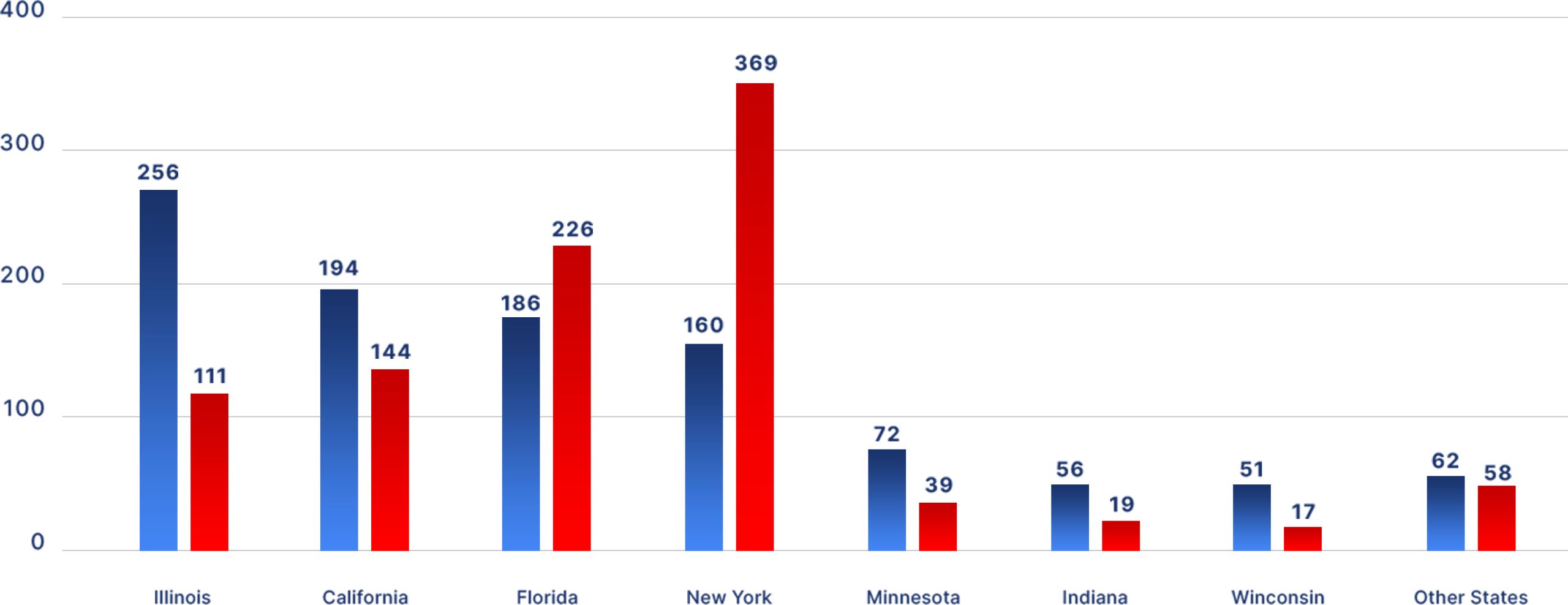
Chart description for ADA Website Lawsuits Filed by State Q1 2026 vs Q1 2025
Bar chart comparing ADA website lawsuits by state in Q1 2026 versus Q1 2025 showing increases in Illinois and California and declines in New York and Florida.
- Illinois recorded the most significant increase, rising from 111 lawsuits in Q1 2025 to 256 in Q1 2026, more than doubling its prior-year total and becoming the leading state for filings.
- California also increased, moving from 144 lawsuits in Q1 2025 to 194 in Q1 2026.
- Florida declined from 226 lawsuits to 186, though it remained one of the most active states overall.
- New York recorded the sharpest drop among the major states, falling from 369 lawsuits in Q1 2025 to 160 in Q1 2026.
- Minnesota, Indiana, Wisconsin, and all other states each posted year-over-year increases, suggesting broader filing activity beyond the historically dominant states.
The shift toward Illinois may suggest that plaintiff firms are becoming more active in jurisdictions outside the states that historically dominated website accessibility filings. Given Illinois’s upward movement in recent reporting, the Q1 2026 results may reflect a continued broadening of filing strategy rather than a one-quarter anomaly. At the same time, the chart alone does not establish a single cause, so this trend is best viewed as a sign of changing venue concentration rather than definitive proof of why filings moved. New York’s decline to fourth place may also reflect a combination of factors rather than one clear explanation. One possible reason is that some defendants may be responding more aggressively to website accessibility claims by remediating issues and contesting cases more directly. Recent case developments suggest that claims may become less attractive in some situations where defendants can show that accessibility barriers have already been addressed.
27 Plaintiffs Filed Over 50% ADA Lawsuits in Q1 2026
A small group of repeat plaintiffs continues to drive a significant portion of ADA website litigation, reinforcing a pattern of concentrated and repeat-driven filings.
| Plaintiff Name | Firm Name | Total Lawsuits | Percentage | Jan | Feb | Mar |
|---|---|---|---|---|---|---|
| Julie Dalton | Throndset Michenfelder, LLC | 67 | 6.46% | 16 | 29 | 22 |
| Perla Mageno | Manning Law, APC | 43 | 4.15% | 24 | 12 | 7 |
| Michael Sandoval | Manning Law, APC | 39 | 3.76% | 10 | 12 | 17 |
| Jesus Torres | Manning Law, APC | 33 | 3.18% | 3 | 14 | 16 |
| Livingston Bennett | Equal Access Law Group, PLLC | 25 | 2.41% | 4 | 8 | 13 |
| Nestor A Proveyer | Adams & Associates, P.A. | 23 | 2.22% | 11 | 8 | 4 |
| Blair Douglass | East End Trial Group LLC | 21 | 2.03% | 21 | 0 | 0 |
| Geovanni Bahena Figueroa | Stein Saks, PLLC | 18 | 1.74% | 8 | 4 | 6 |
| Norma O. Gazonni | Brasil & Brasil, P.A | 17 | 1.64% | 8 | 4 | 5 |
| Lisa Anderson | Equal Access Law Group, PLLC | 17 | 1.64% | 6 | 8 | 3 |
| Arantza Castro | Mendez Law Offices, PLLC | 16 | 1.54% | 6 | 1 | 9 |
| Alvear Enrique | Roderick V. Hannah, Esq., P.A. | 15 | 1.45% | 3 | 3 | 9 |
| Howard Wilson | Stein Saks, PLLC | 14 | 1.35% | 4 | 5 | 5 |
| James Murphy | Gottlieb & Associates | 14 | 1.35% | 14 | 0 | 0 |
| James Watson | J. Courtney Cunningham, PLLC | 14 | 1.35% | 12 | 2 | 0 |
| Carlton Knowles | Gottlieb & Associates | 13 | 1.25% | 6 | 0 | 7 |
| Nelson Fernandez | Roderick V. Hannah, Esq., P.A. | 13 | 1.25% | 13 | 0 | 0 |
| Chelette Dewees | AJG Law Group, PC | 13 | 1.25% | 6 | 4 | 3 |
| Aaron See | Equal Access Law Group, PLLC | 13 | 1.25% | 5 | 5 | 3 |
| Morgan Cole | Equal Access Law Group, PLLC | 13 | 1.25% | 2 | 9 | 2 |
| Kevin Orcel | Stein Saks, PLLC | 13 | 1.25% | 0 | 8 | 5 |
| Rosemarie Ramirez | Stein Saks, PLLC | 13 | 1.25% | 0 | 5 | 8 | Rebecca Hernandez | Manning Law, APC | 12 | 1.16% | 7 | 5 | 0 | Oscar Herrera | Roderick V. Hannah, Esq., P.A. | 12 | 1.16% | 7 | 1 | 4 | Ashley Bahena | Equal Access Law Group, PLLC | 11 | 1.06% | 1 | 6 | 4 | Joannah Harris | AJG Law Group, PC | 11 | 1.06% | 0 | 4 | 7 | Nicholas Pagan | Alberto R. Leal, Esq., P.A. | 11 | 1.06% | 0 | 4 | 7 |
| 27 Plaintiffs Filed 50.53% ADA Lawsuits in Q1 2026 | 524 | 50.53% | 197 | 161 | 166 | |
| 135 Plaintiffs Collectively Filed 49.47% ADA Lawsuits in Q1 2026 | 513 | 49.47% | 150 | 156 | 207 | |
| 162 Plaintiffs Filed 1037 Website ADA Lawsuits in Q1 2026 | 1,037 | 100% | 347 | 317 | 373 | |
Top 5 Plaintiffs
Lawsuits: 207
Percentage: 19.96%
Top 10 Plaintiffs
Lawsuits: 303
Percentage: 29.22%
Top 27 Plaintiffs
Lawsuits: 524
Percentage: 50.53%
Top 52 Plaintiffs
Lawsuits: 731
Percentage: 70.49%
Top Plaintiffs Continued to Drive ADA Website Lawsuits in Q1 2026
The top 27 plaintiffs collectively filed 524 of the 1,037 lawsuits, accounting for 50.53% of all filings during the quarter. Despite a broader pool of plaintiffs, litigation activity remains heavily influenced by a limited number of repeat filers.
Leading Plaintiffs in Q1 2026
- Julie Dalton was the most active plaintiff during Q1 2026, filing 67 lawsuits, representing 6.46% of all quarterly filings.
- Perla Mageno ranked second with 43 lawsuits, accounting for 4.15% of total ADA website lawsuits filed during the quarter.
- Michael Sandoval followed with 39 lawsuits, contributing 3.76% of total quarterly filings.
- Jesus Torres recorded 33 lawsuits, making him the fourth most active plaintiff during Q1 2026.
- Livingston Bennett rounded out the top five with 25 lawsuits, representing 2.41% of all filings during the quarter.
The remaining 135 plaintiffs filed 513 lawsuits (49.47%), indicating that while participation is broad, filing volume remains concentrated among the most active individuals.
10 Law Firms Filed Over 82% ADA Lawsuits in Q1 2026
ADA website litigation remains highly structured, with a limited number of law firms controlling the majority of filings across the United States.
| Plaintiff Firm Name | Total Lawsuits | Percentage | Jan | Feb | Mar |
|---|---|---|---|---|---|
| Equal Access Law Group, PLLC | 291 | 28.06% | 81 | 99 | 111 |
| Manning Law, APC | 147 | 14.18% | 51 | 48 | 48 |
| Gottlieb & Associates | 91 | 8.78% | 39 | 24 | 28 |
| Stein Saks, PLLC | 79 | 7.62% | 15 | 23 | 41 |
| Throndset Michenfelder, LLC | 72 | 6.94% | 18 | 30 | 24 |
| AJG Law Group, PC | 45 | 4.34% | 11 | 15 | 19 |
| Roderick V. Hannah, Esq., P.A. | 45 | 4.34% | 24 | 8 | 13 |
| Joseph & Norinsberg, LLC | 33 | 3.18% | 10 | 10 | 13 |
| NYE Stirling, Hale & Miller, LLP | 27 | 2.60% | 6 | 11 | 10 |
| Mendez Law Offices, PLLC | 26 | 2.51% | 10 | 2 | 14 |
| 10 Law Firms Filed 82.55% ADA Lawsuits in Q1 2026 | 856 | 82.55% | 265 | 270 | 321 |
| 15 Law Firms Filed 17.45% ADA Lawsuits in Q1 2026 | 181 | 17.45% | 82 | 47 | 52 |
| 25 Law Firms Collectively Filed 856 Lawsuits in Q1 2026 | 1,037 | 100% | 347 | 317 | 373 |
Top 5 Plaintiffs
Lawsuits: 680
Percentage: 65.57%
Top 10 plaintiff Firms
Lawsuits: 856
Percentage: 82.55%
Top 14 plaintiff Firms
Lawsuits: 949
Percentage: 91.51%
Plaintiff Firms Continued to Dominate ADA Website Litigation in Q1 2026
ADA website accessibility lawsuits remained highly concentrated among a small group of plaintiff firms during Q1 2026. The top 10 plaintiff firms collectively filed 856 of the 1,037 ADA website lawsuits, accounting for 82.55% of all filings during the quarter. This demonstrates that a limited number of firms continued to control the vast majority of ADA website litigation activity.
Compared to Q1 2025, law firm concentration remained similarly high, reinforcing the continued dominance of repeat plaintiff-side law firms in ADA website accessibility lawsuits. Despite changes in overall filing volume, the structure of plaintiff firm participation remained largely consistent year-over-year.
Leading Plaintiff Firms in Q1 2026
- Equal Access Law Group, PLLC, led all plaintiff firms during Q1 2026, filing 291 lawsuits, representing 28.06% of all quarterly filings.
- Manning Law, APC ranked second with 147 lawsuits, accounting for 14.18% of total ADA website lawsuits filed during the quarter.
- Gottlieb & Associates followed with 91 lawsuits, contributing 8.78% of total quarterly filings.
- Stein Saks, PLLC, recorded 79 lawsuits, making it the fourth most active plaintiff firm during Q1 2026.
- Throndset Michenfelder, LLC, rounded out the top five with 72 lawsuits, representing 6.94% of all filings during the quarter.
Remaining Plaintiff Firm Activity
The remaining 15 plaintiff firms collectively filed 181 lawsuits, accounting for 17.45% of total ADA website lawsuits filed during Q1 2026. While additional firms participated in litigation activity, filing volume remained overwhelmingly concentrated among the top-ranked firms.
Overall, the Q1 2026 data confirms that ADA website litigation continues to be driven by a small group of highly active plaintiff firms, with the top firms responsible for the overwhelming majority of lawsuits filed throughout the quarter.
Industries Affected by Website Accessibility Lawsuits in Q1 2026
Consumer-facing industries with high online interaction and transaction volume continue to face the greatest exposure to ADA website litigation.
| Industry Category | Total Lawsuits | Percentage | Jan | Feb | Mar |
|---|---|---|---|---|---|
| Restaurant, Food, Drinks & Beverages | 334 | 32.21% | 121 | 100 | 113 |
| Lifestyle, Fashion, Clothing & Apparel | 261 | 25.17% | 74 | 92 | 95 |
| Medical & Health | 75 | 7.23% | 26 | 21 | 28 |
| Beauty, Skin & Body Care | 75 | 7.23% | 34 | 16 | 25 |
| Furniture, Lighting, Home Decor & Kitchen Accessories | 72 | 6.94% | 22 | 24 | 26 |
| Retail & Consumer Goods | 45 | 4.34% | 15 | 15 | 15 |
| Pet Care & Accessories | 28 | 2.70% | 4 | 10 | 14 |
| Fitness & Sports Accessories | 24 | 2.31% | 13 | 6 | 5 |
| Computer, Mobile & Electronic Accessories | 22 | 2.12% | 5 | 6 | 11 |
| 9 Industries Faced 90.26% of Lawsuits in Q1 2026 | 936 | 90.26% | 314 | 290 | 332 |
| 12 Industries Faced 9.74% of Lawsuits in Q1 2026 | 101 | 9.74% | 33 | 27 | 41 |
| Total ADA Website Lawsuits by Industry in Q1 2026 | 1,037 | 100% | 347 | 317 | 373 |
Industries Continued to Drive ADA Website Litigation in Q1 2026
ADA website accessibility lawsuits in Q1 2026 remained highly concentrated within a limited number of industries. The top 9 industries collectively accounted for 936 of the 1,037 total lawsuits, representing 90.26% of all filings during the quarter. This level of concentration indicates that ADA website litigation continued to focus heavily on a relatively narrow group of business sectors.
Leading Industries in Q1 2026
- Restaurant, Food, Drinks & Beverages was the most affected industry during Q1 2026, recording 334 lawsuits, or 32.21% of all quarterly filings.
- Lifestyle, Fashion, Clothing & Apparel ranked second with 261 lawsuits, accounting for 25.17% of total ADA website lawsuits filed during the quarter.
- Medical & Health recorded 75 lawsuits, representing 7.23% of all filings.
- Beauty, Skin & Body Care also recorded 75 lawsuits, matching the Medical & Health category at 7.23%.
- Furniture, Lighting, Home Decor & Kitchen Accessories followed with 72 lawsuits, accounting for 6.94% of total filings.
- Retail & Consumer Goods recorded 45 lawsuits, representing 4.34% of quarterly filings.
- Pet Care & Accessories accounted for 28 lawsuits, contributing 2.70% of total ADA website lawsuits.
- Fitness & Sports Accessories recorded 24 lawsuits, representing 2.31% of all filings.
- Computer, Mobile & Electronic Accessories rounded out the top nine with 22 lawsuits, accounting for 2.12% of total quarterly filings.
Most Common Reasons for ADA Website Lawsuits
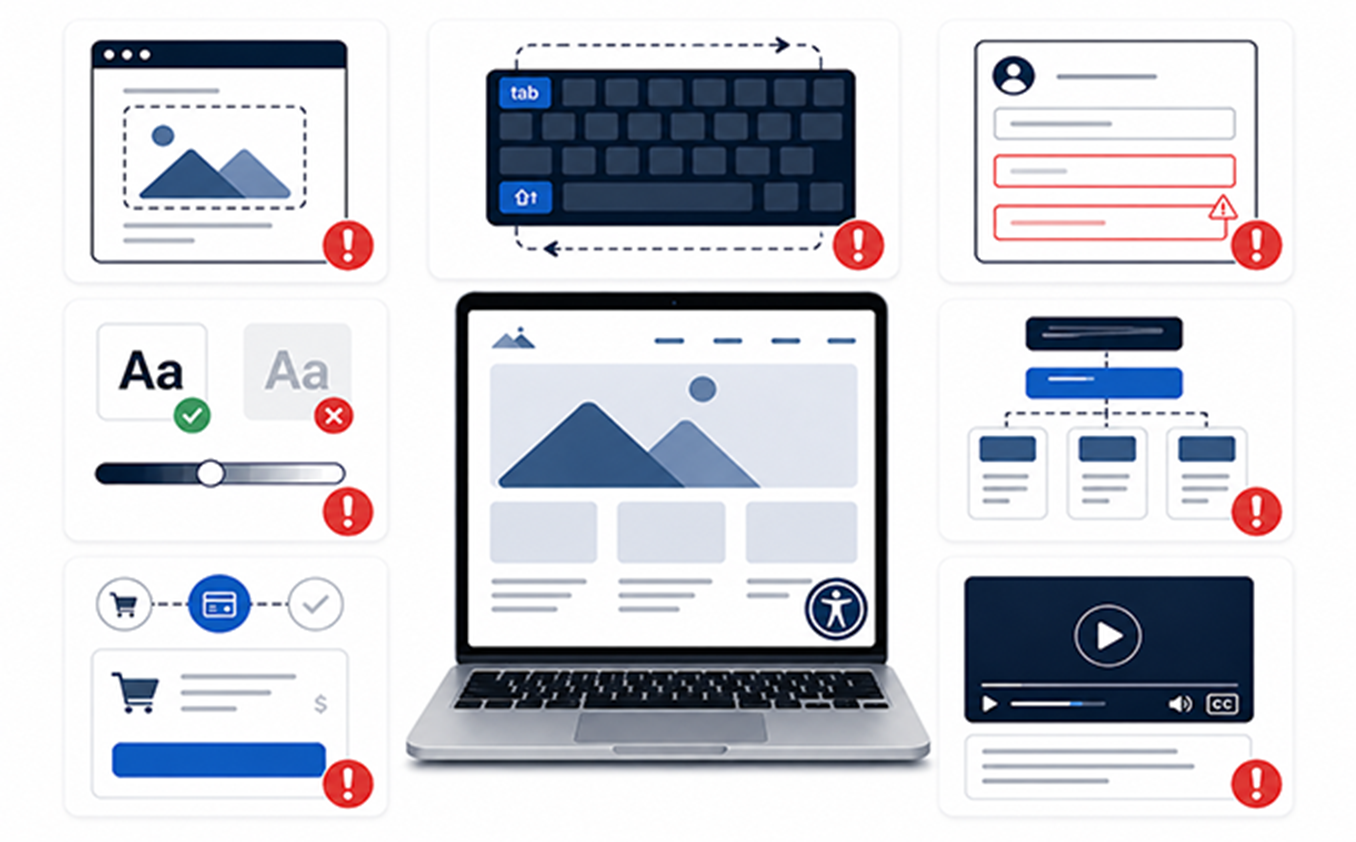
ADA website lawsuits often arise from common and recurring accessibility barriers that make it difficult for users with disabilities to access content or complete important actions on a website. Often, the same types of issues continue to appear across customer-facing websites.
- Missing alt text on images or icons.
- Poor keyboard navigation that limits access without a mouse
- Inaccessible forms with missing labels, instructions, or error messages
- Low color contrast that makes content difficult to read
- Poor page structure that affects screen reader navigation
- Barriers in checkout, booking, or registration flows
- Videos without captions or transcripts
These recurring issues continue to be among the most common reasons businesses face ADA website accessibility lawsuits.
Implications for Businesses
The Q1 2026 data shows that businesses in consumer-facing industries remain at higher risk, especially those that depend on e-commerce, online ordering, appointment scheduling, or other website-based transactions.
- Websites used for shopping, booking, or service access face greater legal exposure
- Accessibility barriers in key customer journeys can increase litigation risk
- High-visibility industries continue to attract the most plaintiff activity
Recommendations
Businesses in the most affected industries should approach accessibility as an ongoing compliance effort rather than a one-time fix.
- Conduct regular accessibility audits
- Test customer-facing features such as forms, checkout, and booking tools
- Build accessibility into website updates and ongoing maintenance
- Work with experienced accessibility professionals to reduce risk early

Conclusion
The Q1 2026 industry data shows that ADA website lawsuits remained heavily concentrated in a small number of sectors, especially those with strong direct-to-consumer digital activity. This reinforces the need for businesses to treat accessibility as an essential part of website management, compliance, and customer experience.
ADA Lawsuits Filed Against Accessibility Widgets Q1 2026 vs Q1 2025
The rise in widget-related lawsuits suggests that reliance on automated accessibility tools without comprehensive remediation may increase legal exposure. Websites using accessibility widgets continued to face substantial ADA website litigation during Q1 2026. A total of 265 lawsuits involved websites with accessibility widgets installed, representing 25.55% of all ADA website lawsuits filed during the quarter. This reflects a notable increase compared to 209 widget-related lawsuits in Q1 2025, showing that legal scrutiny surrounding widget-based accessibility solutions remained elevated year-over-year.
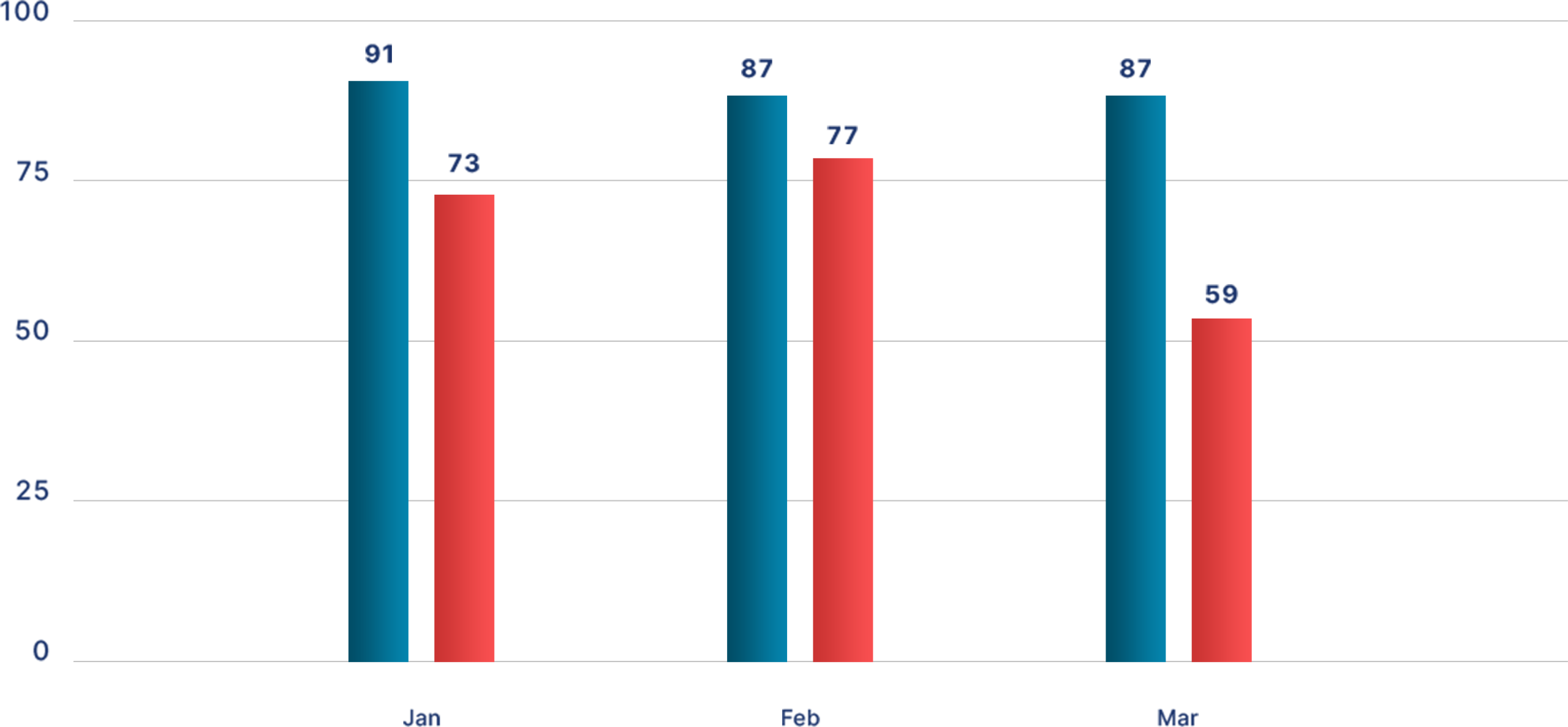
Chart description for ADA Lawsuits Filed Against Accessibility Widgets Q1 2026 vs Q1 2025
Bar chart comparing monthly accessibility widget related website lawsuits in Q1 2026 and Q1 2025 showing higher lawsuit counts in all three months of 2026.
The quarterly comparison shows widget-related lawsuits increased steadily throughout Q1 2026, with 91 cases in January, 87 in February, and 87 in March, compared to 73, 77, and 59 during the same months in Q1 2025. This continued rise suggests that businesses relying on overlay or widget-based accessibility tools remain frequent targets in ADA website litigation despite broader market awareness of accessibility compliance requirements.
ADA Lawsuits Filed by Web Platforms in Q1 2026
Platform usage alone does not determine compliance risk – implementation quality and ongoing accessibility practices play a critical role.
Many businesses rely on website platforms to build and manage their online presence. While these platforms may provide accessibility tools and features, ADA-related lawsuits can still arise when accessibility is not properly addressed during website development. Responsibility for ADA compliance ultimately remains with the website owner. Accessibility tools can help support compliance, but their effectiveness depends on how well they are implemented, maintained, and used.
SHOPIFY
A user-friendly ecommerce platform that helps businesses create, manage, and grow online stores with flexible tools for businesses of all sizes.
Lawsuits: 459
Percentage: 44.26%
WordPress
A versatile content management system that offers extensive customization through a wide range of plugins, themes, and built-in features.
Lawsuits: 150
Percentage: 14.46%
Squarespace
A user-friendly platform that helps businesses create and manage professional websites with built-in design tools and a polished visual experience.
Lawsuits: 39
Percentage: 3.76%
Salesforce COMMERCE CLOUD
A cloud-based ecommerce platform built for large-scale businesses, offering advanced features, scalability, and enterprise-level capabilities.
Lawsuits: 39
Percentage: 3.76%
Bigcommerce
A scalable ecommerce platform designed to help businesses build, manage, and grow online stores with powerful built-in features.
Lawsuits: 26
Percentage: 2.51%
custom-coded websites
Custom-built websites developed to meet specific business needs, offering unique design, functionality, and a more tailored user experience.
Lawsuits: 324
Percentage: 31.24%
Platform Trends and Q1 Comparison
Platform data for Q1 2026 shows that Shopify remained the most frequently identified platform in ADA website accessibility lawsuits, accounting for 459 lawsuits or 44.26% of all filings. While Shopify maintained its position as the leading platform, its share of lawsuits increased significantly compared to Q1 2025, when it accounted for 325 lawsuits (33.06%), reflecting continued growth in Shopify-related litigation.
WordPress remained the second most cited platform, though its share declined notably from 195 lawsuits (19.84%) in Q1 2025 to 150 lawsuits (14.46%) in Q1 2026, suggesting reduced concentration compared to the prior year.
Salesforce Commerce Cloud recorded a slight decline from 44 lawsuits (4.48%) in Q1 2025 to 39 lawsuits (3.76%) in Q1 2026, while Squarespace increased from 26 lawsuits (2.64%) to 39 lawsuits (3.76%), matching Salesforce in total quarterly filings.
BigCommerce accounted for 26 lawsuits (2.51%) in Q1 2026, while Other Custom Coded Websites remained a major category with 324 lawsuits, representing 31.24% of all filings. Although slightly lower than 330 lawsuits (33.57%) recorded in Q1 2025, custom-coded websites continued to represent a significant portion of ADA website litigation.
Overall, the Q1 2026 platform data suggests that ADA website accessibility litigation remained heavily concentrated among major e-commerce and CMS platforms, with Shopify showing the most substantial year-over-year increase and strengthening its lead as the most frequently cited platform in website accessibility lawsuits.
Key Legal & Market Developments (Jan – Mar 2026) Impacting ADA Website Lawsuits
Over the past three months, ADA website litigation has not slowed down in volume, but the underlying dynamics have clearly evolved. Several legal decisions, legislative efforts, and enforcement actions are reshaping how and where lawsuits are being filed.
Continued High Filing Volume Driven by Repeat Litigation
One of the strongest drivers of ongoing lawsuit activity is the rise in repeat defendants. A significant portion of recent cases involves businesses that have already faced ADA lawsuits in the past. This indicates that:
- Initial settlements are often not resolving accessibility issues fully
- Plaintiffs are re-targeting previously sued businesses
- Accessibility gaps remain unaddressed or reintroduced over time
This trend alone is sustaining high filing numbers and reducing the likelihood of a sharp decline in lawsuits.
Shift in Filing Strategy Due to Court Scrutiny (Especially in New York)
Recent rulings in Fernandez v. Cuddle Clones highlight growing judicial skepticism toward repetitive filings.
Key impact:
- Courts are questioning plaintiff intent and credibility
- Increased scrutiny around “intent to purchase” claims
- More cases facing jurisdictional challenges in federal courts
Result:
Instead of reducing lawsuits overall, this is causing a shift from federal courts to state courts, particularly in jurisdictions perceived as more favorable to plaintiffs.
Mootness Defense Gaining Strength
A major development came from Jones v. Moscot, where the case was dismissed after the defendant proved the website had already been remediated.
Key takeaways:
- Courts are accepting real remediation as a valid defense
- Defendants with:
- Proper documentation
- Expert-backed accessibility audits
- Verified fixes
Have a stronger chance of dismissal
Impact on filings:
- Weak or opportunistic lawsuits may decrease
- But strong claims will continue, especially where issues persist
New Legal Openings in Certain States
State-level developments, such as expanded interpretations of accessibility laws (e.g., Washington), are creating new filing opportunities.
- Some states may allow claims without strict federal nexus requirements
- This can expand litigation beyond traditional hotspots like:
- New York
- California
- Florida
Conclusion
The first quarter of 2026 confirms that ADA website accessibility litigation remains a significant and evolving legal risk for businesses. With 1,037 lawsuits filed, the data reflects continued high activity driven by repeat plaintiffs, concentrated law firm involvement, and ongoing accessibility gaps across industries and platforms.
Rather than declining, litigation is becoming more targeted and structured, with a clear focus on high-risk industries, frequently used platforms, and businesses that have not implemented comprehensive accessibility practices.
As regulatory attention and legal scrutiny continue to increase, businesses should move beyond one-time fixes and adopt a proactive, long-term approach to accessibility. This includes regular audits, proper remediation at the code and content level, and continuous monitoring to reduce legal exposure and improve user experience.
Website accessibility is no longer optional—it is a critical component of compliance, risk management, and inclusive digital experience.
EcomBack Helps Businesses Build More Accessible and Compliant Websites

Remediation
EcomBack identifies and resolves accessibility barriers by improving code, refining content structure, and helping ensure compatibility with assistive technologies.

Accessibility Audits
Our human experts conduct detailed accessibility audits on a monthly, quarterly, bi-annual, or annual basis to uncover issues that automated tools often miss and to support ongoing ADA compliance.

Ongoing Monitoring
We provide continuous accessibility monitoring to help websites remain compliant as new content, features, and updates are introduced

Staff Training
EcomBack offers practical training modules that equip your team with the knowledge and tools needed to implement and maintain accessibility best practices.

Accessibility Statement
We help create clear and effective accessibility statements that reflect your commitment to inclusive digital experiences.

Usability Testing
Certified testers with disabilities perform real-world testing to assess your website’s accessibility, usability, and overall user experience.
Why Choose EcomBack?
Real Accessibility Fixes for Code and Content: We do more than patch surface-level issues. EcomBack delivers true website remediation by fixing accessibility barriers at their source across both code and content. From images, tables, PDFs, and videos to overall structure and functionality, we help create websites that are genuinely accessible and built to stay that way.
Trusted Expertise That Stands Out: EcomBack is recognized for delivering thorough, credible, and results-driven accessibility remediation. As a court-approved remediation service provider and a proud member of both the W3C and IAAP, we bring proven knowledge and industry trust to every project. Our careful and neutral process has also made us a reliable partner for leading defense firms.
Free Initial Audit to Get Started: We make the first step simple. Our free website audit and consultation help uncover accessibility issues, explain your current compliance position, and show where improvements are needed most.
Affordable Support for Long-Term Compliance: Accessibility is not a one-time task. Our cost-effective services help businesses not only reach compliance but continue to maintain it with confidence over time.
Ongoing Audits and Maintenance: Websites change constantly, and accessibility should keep up. That is why we offer monthly, quarterly, bi-annual, and annual audit plans to catch new issues early and keep your website aligned with ADA requirements.
Practical Staff Training: A well-informed team is essential for lasting accessibility. We provide training that gives your staff the knowledge and confidence to understand requirements, avoid common mistakes, and apply accessibility best practices in everyday work.
Real-World Testing by Certified Disabled Testers: The best accessibility insights come from people who rely on assistive technologies every day. Our certified disabled testers bring real user experience into the process, helping ensure your website is not only technically compliant but also intuitive, inclusive, and easy to use.

Hire EcomBack as Your Trusted Digital Accessibility Partner
Build a more accessible, inclusive, and compliant website with EcomBack’s expert web accessibility services. We help businesses meet ADA and WCAG requirements while creating a better online experience for all users, including people with disabilities.
Our process starts with a detailed accessibility audit to uncover compliance issues and usability barriers. We then improve your website’s content and code to create a stronger, more accessible digital experience. With ongoing monitoring and support, we help you maintain compliance, lower legal risk, and stay aligned with your long-term accessibility goals.
This report is published in accordance with our Website Content Disclaimer
Professional Standing
These affiliations underline our credibility and expertise, ensuring your website is reviewed by industry leaders in accessibility.

International Association of Accessibility Professionals (IAAP)
Demonstrating our commitment to advancing accessibility expertise.

World Wide Web Consortium (W3C)
As part of the WCAG working group, we actively contribute to the development of global accessibility standards.

Court Approved Providers
EcomBack is a court-approved accessibility provider in a consent decree, further highlighting our recognized expertise in ensuring compliance with accessibility laws.


