
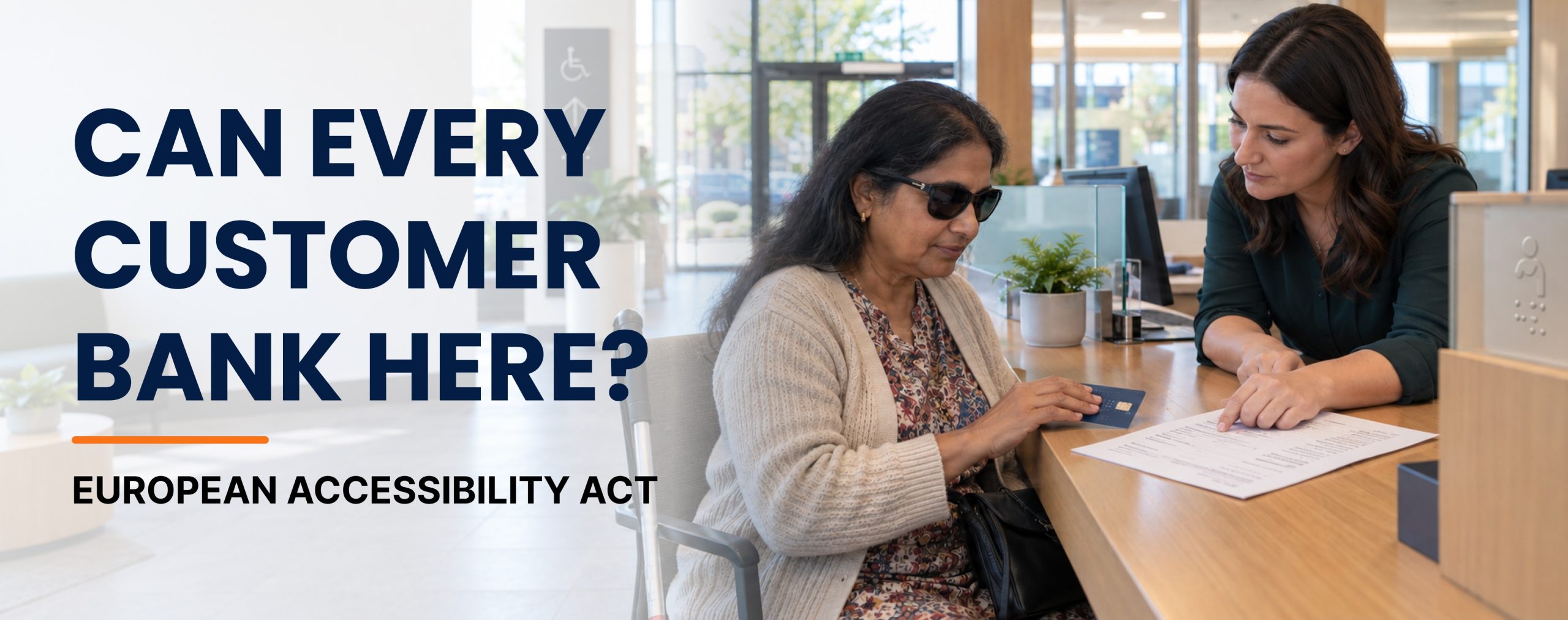
The European Accessibility Act (EAA) establishes a legal requirement for banks operating in the European Union to ensure that their digital services are accessible to all users, including people with disabilities. At its core, the EAA is grounded in the principle that digital services must be perceivable, operable, understandable, and robust.
Since the enforcement date of June 28, 2025, businesses must ensure that their services meet accessibility requirements aligned with internationally recognized standards.
The EAA applies to consumer-facing banking services, including:
- Online banking websites
- Mobile banking apps
- ATMs and self-service kiosks
- Digital documents (statements, contracts)
- Customer support channels
Banks often face challenges in achieving compliance, particularly due to legacy systems, complex workflows, and the need to balance stringent security requirements with accessibility. However, failure to comply with the EAA can result in regulatory penalties, legal risks, and reputational damage, as well as the exclusion of a significant portion of the population from essential financial services.
Understanding the EAA Requirements
To comply with the EAA, banks are expected to align their digital platforms with WCAG 2.1 Level AA and the European standard EN 301 549, which provides detailed technical specifications for accessibility in information and communication technologies. For example, content must be perceivable by users with different sensory abilities, meaning that images require descriptive alternative text, videos must include captions or transcripts, and color contrast must be sufficient to ensure readability.
The EAA for Banking
In the context of banking, this also means that critical information such as account balances, transaction histories, and financial charts must be accessible to screen readers and other assistive technologies.
Beyond general accessibility principles, the EAA places particular emphasis on banking-specific functionalities.
- Security processes must be secure and inclusive.
- Multi-factor authentication should be designed with accessibility in mind.
- One-time passwords should be accessible via screen readers, and users should not be forced to complete inaccessible visual challenges.
- All transactional capabilities, including payments, transfers, and account management features, must be fully accessible, ensuring that users with disabilities can independently manage their finances.
- Digital documents, which are a critical component of banking services, must meet accessibility requirements. This includes providing account statements and contracts in accessible formats such as PDF, ensuring that documents are properly tagged and readable by assistive technologies. Banks should also be prepared to offer alternative formats, such as large print or braille, upon request.
- Customer communication channels, including email, chat, and help centers, must be accessible as well, and banks should provide multiple ways for users to seek assistance, accommodating different needs and preferences.
Mobile banking apps require particular attention, as they must integrate with platform-specific accessibility features on iOS and Android devices. This includes supporting screen readers, enabling text resizing, ensuring sufficient contrast, and providing alternatives to gesture-based interactions. Notifications, navigation elements, and interactive components must all be designed with accessibility in mind to ensure a seamless user experience across devices.
Always Keep Accessibility in Mind
EAA compliance requires that every aspect of the digital customer journey is inclusive, secure, and usable. It is not a one-time effort but an ongoing commitment that must be embedded into design, development, and operational practices.
At EcomBack, we help banks with a comprehensive audit of their digital services to identify gaps relative to WCAG and EN 301 549 standards. We then prioritize remediation efforts, focusing first on critical user journeys such as authentication, payments, and account access. After implementing necessary fixes, the EcomBack team validates compliance through a combination of automated testing, manual evaluation, and user testing involving people with disabilities.


