
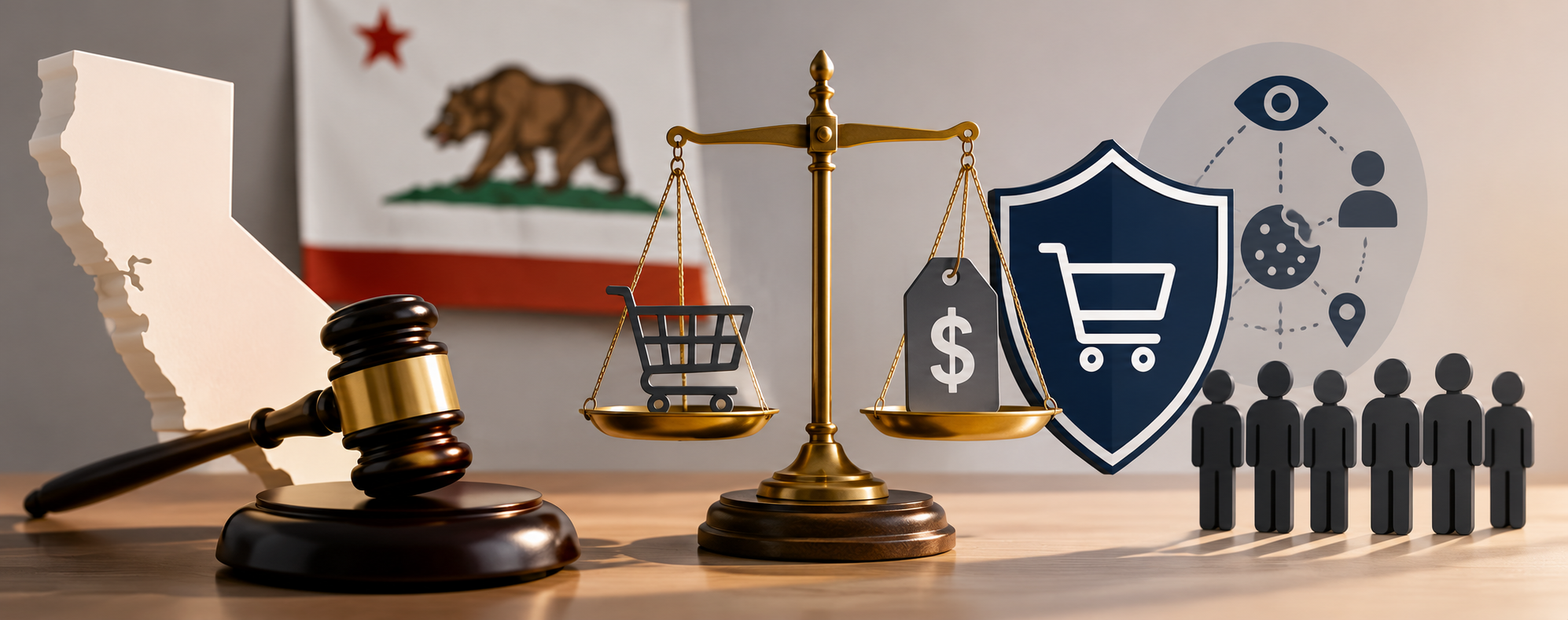
How a well-intentioned “surveillance pricing” bill could hand a brand-new weapon to the same kinds of firms behind website demand letters — even against stores that aren’t based in California.
If you sell online, you already know the drill. A demand letter lands in your inbox. A law firm you’ve never heard of claims your website violated some law. And suddenly you’re weighing the cost of a settlement against the cost of a fight. Accessibility (ADA) lawsuits work this way. So does the wave of California “wiretapping” demand letters over ordinary tracking pixels and chat widgets. Now California is advancing a bill that could open a third front — and most online sellers haven’t heard of it yet.
It’s called AB 2564, the “Surveillance Pricing” bill. It has already passed the California Assembly and is awaiting a vote on the Senate floor. Here’s what merchants need to understand before it becomes law and here is a link to join a free webinar to understand how this bill can impact your business.
What AB 2564 actually does
AB 2564 would prohibit “surveillance pricing” — setting or offering a customized price for a specific customer based on personal information collected through “electronic surveillance technology.” That phrase is defined broadly enough to cover the everyday tools nearly every online store runs: device tracking, behavioral data, and information about a shopper’s browsing and purchase history, including data acquired from third parties.
The bill’s supporters are aiming at a real concern — companies using detailed personal data to quietly charge some shoppers more. But the bill’s definition doesn’t distinguish between charging someone more and offering someone a deal. It sweeps in any “customized price” built on customer data, whether the price goes up or down.
Why this lands on e-commerce specifically
Think about the marketing tools online sellers use every day:
- The cart-abandonment email with a 10%-off code to win back a shopper who didn’t check out.
- The win-back offer to a customer who hasn’t ordered in a few months.
- Personalized coupons based on what someone has browsed or bought before.
Every one of these uses data about an individual shopper to offer that shopper a customized price. The bill does carve out broad, publicly posted, uniformly available discounts — student and military discounts, loyalty programs customers sign up for, sitewide promo codes. But the individualized, behavior-triggered offers that power modern e-commerce are exactly the ones sitting in the gray zone.
The bill wouldn’t necessarily ban those offers outright. What it would do is wrap them in a documentation-and-uniformity regime — you’d have to publicly post the eligibility terms and make each discount uniformly available to everyone who qualifies. For a large retailer with a compliance department, that’s a line item. For a small online seller, it’s real legal uncertainty over routine, everyday marketing.
The part that matters most: the lawsuit engine
Here’s where the pattern will look familiar. AB 2564 doesn’t rely on government enforcement alone. It includes a private right of action — it lets consumers sue for injunctive relief plus attorney’s fees.
If you’ve followed the ADA website-lawsuit wave or the CIPA – California pixel demand letters, you already know that attorney’s-fee shifting is the fuel. A plaintiff doesn’t have to prove real harm or win a big judgment at trial. The mere threat of having to pay the other side’s legal fees is often enough to make settling the cheaper option. That’s the exact mechanism that turned a 1967 wiretapping statute into thousands of California demand letters against ordinary business websites.
And here’s the twist most people have missed.
California is trying to shut these lawsuits down — with the other hand
At the very same time, the California Legislature is moving a separate bill, SB 690, designed specifically to curb the website-lawsuit epidemic. SB 690 would strip the private right of action for those website-tracking claims and hand enforcement to the state Attorney General instead. It cleared the Assembly’s Privacy and Consumer Protection Committee unanimously (14–0) on July 1, 2026.
Put the two side by side:
- SB 690 takes the private-lawsuit weapon away from the firms flooding online sellers with demand letters.
- AB 2564 hands those same kinds of firms a brand-new private-lawsuit weapon — aimed at the same websites, the same customer data, with the same attorney’s-fee shifting that makes demand letters profitable in the first place.
In one legislative session, over the same online stores, California is moving to tear a litigation tool down and build a new one up at the same time.
“But I’m not in California”
Neither are most of the businesses already getting hit by California website lawsuits. These laws tend to follow the California shopper, not the seller. If a California resident visits your store and you’re using the covered data and pricing tools, you can be pulled into a California court no matter where your business is based. National sellers have learned this the hard way with ADA and wiretapping claims already.
What online sellers should do now
AB 2564 hasn’t passed yet — it still faces a Senate floor vote before the Legislature’s end-of-session deadline. That makes right now the moment for online sellers, and the trade groups that represent them, to pay attention. A few practical steps:
- Know your own stack. Get clear on which of your promotions are individualized and data-driven (cart recovery, win-back, personalized coupons) versus broadly posted and uniformly available to anyone.
- Watch the bill. AB 2564 and SB 690 are both moving quickly and being amended. The details — especially who can sue and for what — matter a great deal.
- Make your voice heard. If personalized offers are part of how your store competes and serves customers, your representatives should hear that from the sellers who would actually be affected.
Online sellers have spent years learning to protect their websites from litigation risk. AB 2564 is the next one worth watching closely.
Join a free webinar on AB 2564
Want to understand exactly what AB 2564 means for your store — and what you can do before California’s Senate votes? Join a free webinar hosted by Connected Council for a plain-English breakdown of the bill, the litigation risk for online sellers, and how to make your voice heard.
📅 When: Wednesday, July 29, 2026, 2pm CST
🎤 Featuring: Nayan Padrai, Founder, EcomBack and Entrepreneur
💻 Where: Online via Zoo
⏱ Length: 1 Hour
Seats are limited — register today so you don’t miss it.
Can’t join? Write to your lawmakers today in 1 minute. Here is the link
This article is for general information and is not legal advice. AB 2564 and SB 690 are both being actively amended; confirm the current bill text before relying on any specific detail.


